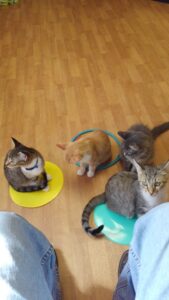
Teaching cats to go to a location on cue can be very helpful for various situations. It can be a great skill for cats who try to escape confinement or the house, those who jump up onto counters when you are cooking and can even be a helpful skill when introducing a new member to the family.
Choosing a Station
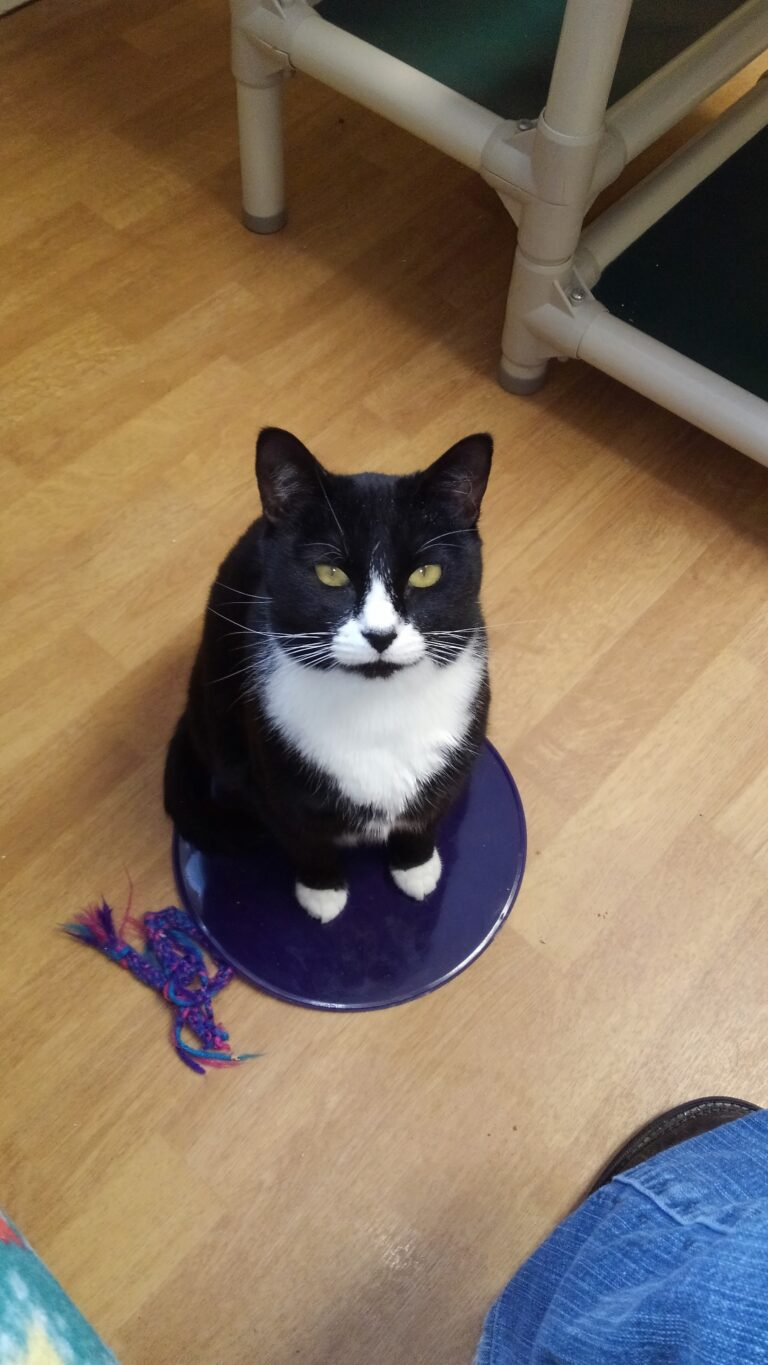
Many cats have texture and location preferences already. Choosing something that already fits within your cat’s current comfort zone will help training progress faster. It is helpful if the station is either raised or a different texture than the surroundings or both. For example, a silicone mat may work well on carpet but may be harder to be successful at least initially if it is placed on linoleum flooring. Some cats prefer a place that is up, but having an item that can also be on ground level that does not require jumping is a great option for cats with mobility changes.
Having the mat or station in your home for a week or so before training with it can be helpful. During this time it can pick up the smells of your house but should be kept out of sight. This is not a mandatory step but can be helpful for cats who fear things that don’t smell like home. If you are using a blanket, you can wash it with some other items that your cat uses already to help it smell less new.
Getting Started
Clicker training is a great way to clearly communicate with cats. If you and your cat are not familiar with clicker training, start with some basic click = treat practice. Here is a video to show you how to get started with clicker training https://youtu.be/CTmoETwVmWw.
Once cats understand the clicker, you can use shaping, luring, or capturing to teach new behaviors. Luring is a fairly straight forward training method. Hold the food lure in front of the cat’s nose. Move the food toward the station. Click and treat when the cat steps onto the station. If the cat is hesitant to follow a treat, take some time to reinforce (click and treat) for just leaning or stepping towards the food lure. Many cats do not have a history of learning new things. It takes effort to learn how to learn.
Shaping is a method that allows cats to try things on their own and reinforces steps in the right direction. This often works well in combination with luring but can be hard to use alone in cats who have never had to work for food before. Here is a video showing how shaping works to build a place behavior https://youtu.be/ADcgaxzHgvw. Behaviors taught through shaping often remain strong long after they are taught.
Building Fluency
The goal is to have a cat who is willing to station right away, without hesitation, correctly, at a distance from you, for extended time, and around reasonable distractions. Fluency refers to all these components. It is important during training to only increase one component of difficulty at a time. For example, time that the cat is expected to stay could be increased during one session, but the amount of distraction present should remain the same. Take time to work through various components of fluency until the stationing behavior is able to be performed in a training environment that is almost identical to the practical application.
.